University of Colorado Anschutz · Class of 2028
I'm Bryce Hoppe — a third-year dental student who chose this field because it sits at the intersection of the three things I love most: science, art, and genuine connection with people.
At a glance
This site is a transparent look at my journey through dental school — the clinical experiences I'm accumulating, the research I find compelling, and the long road toward practice ownership.
I believe that dentistry done well demands science, artistry, and genuine human connection in equal measure. Explore the pages below to learn more about what drives me, what I'm working on, and where I'm headed.
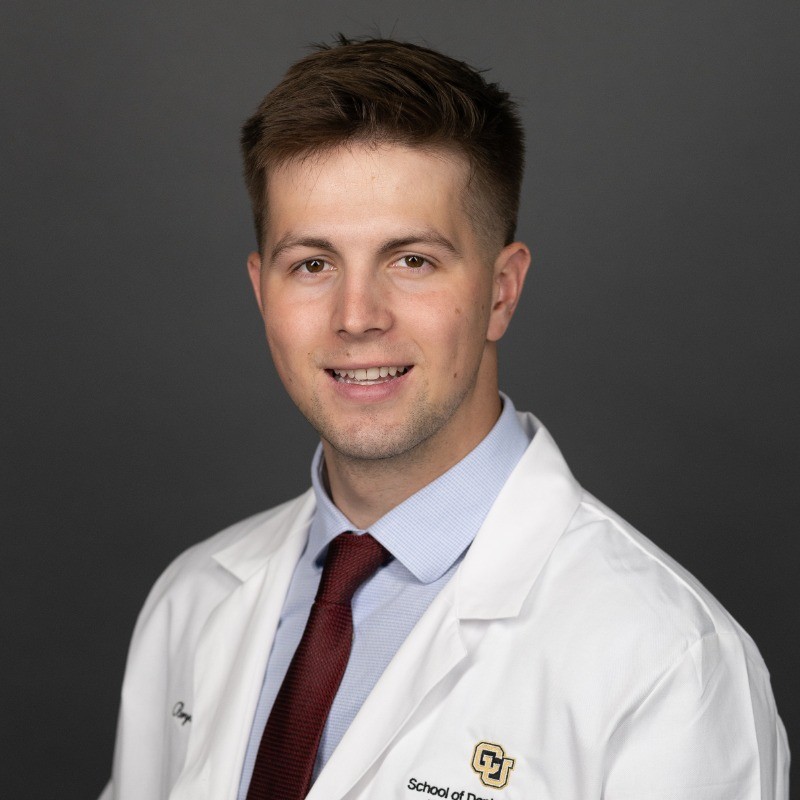
Background
I chose dentistry because it demands all three of the things I care about most. The science keeps me sharp, the artistry keeps me engaged, and the relationships with patients make it meaningful. It's the rare career where all three are non-negotiable — and that's exactly what drew me to it.
My real introduction to the field came before dental school, working alongside Dr. Craig Madsen at Madsen & Hirsch in Madison, Wisconsin. Watching a high-functioning, patient-centered practice operate from the inside — the clinical thinking, the long-term patient relationships, the standard of care a truly excellent dentist maintains — set the bar for the kind of dentist I want to become.
I grew up in Madison and have since lived in Minnesota, Arizona, and Colorado, which gave me a broad sense of how different communities relate to healthcare. I don't believe in a one-size-fits-all approach to anything, especially not patient care.
I also competed as a varsity swimmer at the University of St. Thomas — an experience that taught me early that precision and composure under pressure aren't optional. They're the baseline.


Clinical focus
These are the areas where I find myself thinking the most, reading the most, and feeling the most engaged when I'm in clinic.

The journey
An honest look at the path — the milestones, the learning curves, and the long road ahead.


Clinical experience
A running log of the clinical work I've performed as a third-year dental student at CU Anschutz. All patient information is de-identified in accordance with HIPAA guidelines.


A note on documentation: This page will grow as my clinical experience does. Photos of my own work will be added over time as cases are completed and appropriately documented. Written descriptions reflect genuine clinical encounters with all identifying information removed.
Research & Reading
Studies and ideas worth sharing — with a note on what they actually mean in the clinic, not just on the page. Updated as I go.
This paper lays out a structured, step-by-step digital workflow for rehabilitating patients who have lost — or are about to lose — all of their teeth. The approach starts with digital data capture to build a virtual patient, converts a 2D smile design into a 3D full-arch prosthesis plan, uses CBCT and intraoral scan data to finalize the prosthetic design, and then guides immediate implant placement and loading through a stackable surgical guide system. The goal is to place implants and deliver a provisional prosthesis in the same appointment while protecting soft tissue architecture from day one.
What stands out is how much of the treatment is designed before a single tooth is extracted — the prosthetic outcome drives the surgical plan, not the other way around. Full-arch implant cases are among the most complex in our field, and this kind of systematic digital workflow is what separates predictable outcomes from guesswork. That's a mindset worth internalizing early in training.
This systematic review examined whether using L-PRF — a concentrated fibrin matrix made from the patient's own blood — at the time of implant placement leads to better stability outcomes. After screening nearly 2,000 studies and narrowing to 7 high-quality randomized and controlled clinical trials, the authors found that L-PRF appears to enhance implant stability scores, accelerate healing, and potentially shorten the time between placement and final loading. Because it's derived from the patient's own blood, there's no risk of rejection or adverse reaction.
Early implant stability is one of the biggest variables in whether a case succeeds long-term. If applying a patient's own concentrated blood product at the surgical site can meaningfully improve those numbers, that's a technique worth understanding now — not after residency. There's something compelling about leveraging the body's own biology to do the heavy lifting. The best healing agent we have is still the patient themselves.
More entries coming as I read. Check back regularly — this page grows with my training.
Connect
Whether you're a future patient, a colleague, or a program that values someone who takes both the craft and their own development seriously — I'd love to hear from you.
I welcome outreach from future patients, fellow dental students, mentors, residency programs, or anyone interested in connecting around dentistry, AI in healthcare, or practice ownership. I try to respond to every message.
I typically respond within a few days.